
Collin County City Directory Holdings
Collin County's surviving directory record is uneven, but it is unusually well identified. The local shelf begins with McKinney business books from 1878-79 and 1884-85, moves through a 1902 Daily Gazette volume, and resumes in selected later runs. Plano materials take a different route through telephone books and later directories. Plano Public Library Research & Learn is the verified starting point for asking about a particular volume, while W.O. Haggard Library and the Collin County Genealogical Society preserve the strongest local-history path. Treat a holding list as a lead. Each listed format requires confirmation.
| Collection | Years | Where held | Access route |
|---|---|---|---|
| McKinney Business Directory | 1878-79; 1884-85 | Haggard/CCGS holding and digitization leads | Confirm format with the collection |
| Daily Gazette Directory, McKinney | 1902 | Local holding list | Verify shelf, film, or scan status |
| McKinney directories and Con Survey series | 1933, 1938; 1948, 1949, 1953, 1956, 1960, 1964, 1968, 1971, 1975, 1977 | Haggard/CCGS; UNT projects | Name, address, business, and phone clues |
| McKinney City Directory | 1956 | UNT Portal to Texas History | Free 357-page scan |
| Plano directories and telephone books | 1980-81; 1944, 1947 | CCGS project list | Confirm current access before a visit |
There is no evidence of a complete annual run for every Collin County community. McKinney has additional named editions from 1982, 1984, and 1985, and a 1917 telephone book is also listed. A missing year can reflect non-survival, a different publisher, or a volume still awaiting description. Record the title, date, and repository with every finding so a later check can return to the same edition.
Collin County Directory Shelf
W.O. Haggard Library, at 2501 Coit Road in Plano, is the local genealogy route for Collin County directory research. The Collin County Genealogical Society, or CCGS, began in 1970 as the Plano Genealogical and Historical Society and adopted its present name in 1979. It reports more than 50 continuous years at Haggard. Along with directories, its work includes newspaper preservation, cemetery surveys, transcriptions, books, and Collin Chronicles. That combination matters when a name fades from a printed volume and a family needs another dated local source.
The CCGS history and project information provides the clearest public route for collection questions. Ask whether a desired title is available at Haggard, whether it has a reverse or criss-cross section, and whether staff can point to a newspaper, yearbook, obituary, or cemetery companion. The full subscription and shelf inventories were not verified. Confirm onsite database access and any reference-only rule before relying on a trip from another part of Collin County.
The Haggard Library collection page is the public starting point for the branch and its associated genealogy route.
That public library route connects a Collin County search to local-history staff and the CCGS collection rather than assuming a single online catalog holds every volume.
Collin County Digital Directory Scans
UNT's Portal to Texas History is the free digital counterpart to the physical shelves. Its Collin Chronicles collection showed 138 items, including 36 from the 1980s, 38 from the 1990s, 35 from the 2000s, 20 from the 2010s, and 9 from the 2020s when researched. CCGS supplied material to the portal and has monitored further digitization. Search the collection by place, personal name, title words, and date, but do not treat the item count as proof that every surviving directory is already scanned.
For a known edition, the item record is important evidence. It identifies the repository, the date, and often the contributor. A collection page can uncover newspapers, oral histories, and other Collin County material that helps test a directory lead. Save the stable item link and the page number from a scan. OCR may miss initials, short street names, or marks printed in small type.
The UNT Collin Chronicles collection is the online entry point for selected digitized Collin material.
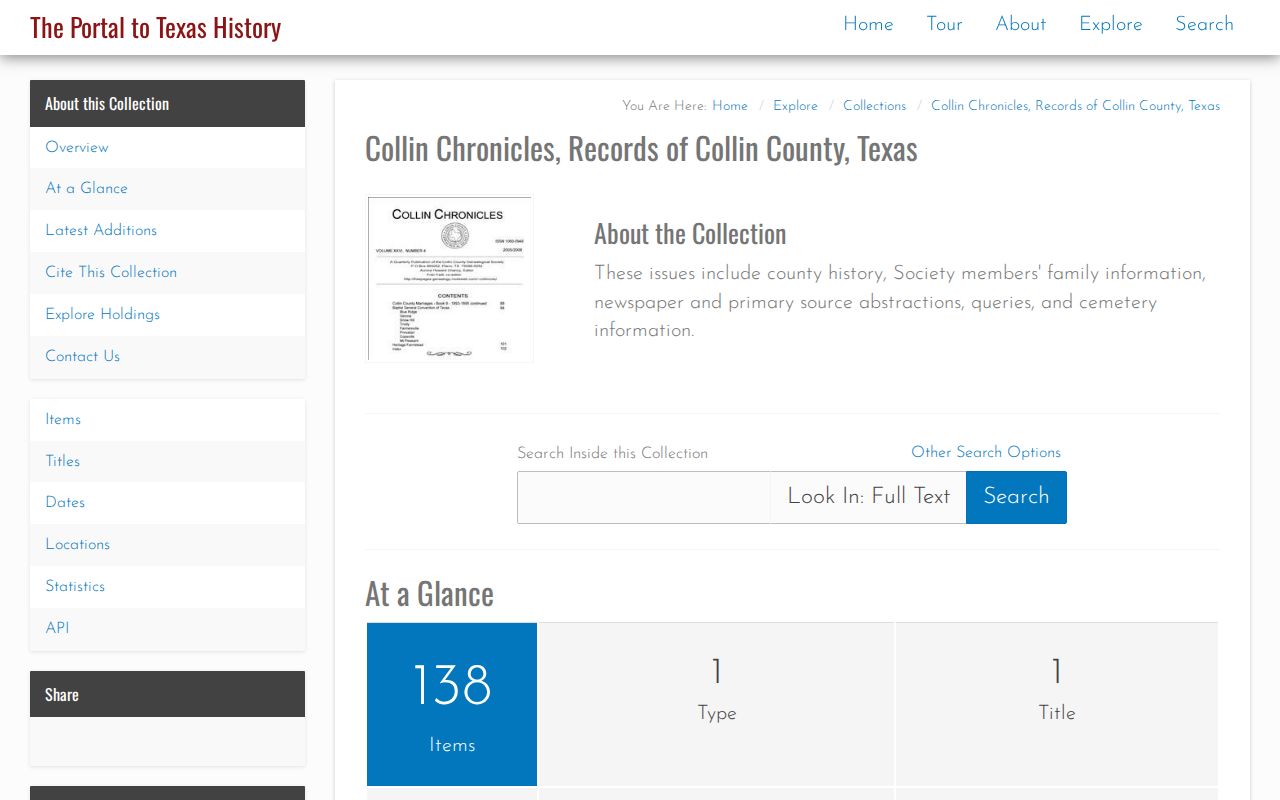
The portal gives Collin County researchers a free way to inspect selected digitized material, while Haggard and CCGS remain the fallback for a year that has not appeared online.
Collin County's 1956 McKinney Directory
The verified 1956 McKinney scan is a useful model for reading a dated volume. It has 357 pages, names Mullin-Kille as compiler and W.E. Parks as publisher, and was supplied by CCGS with a Collin County Historical Commission grant. The item description identifies individual, business, legal, and phone address listings plus advertisements. It does not prove that every kind of entry or abbreviation occurs on every page, so the actual page image remains the authority for a particular name.
The 357-page volume joins address, telephone, and advertisement clues from one period, but it remains a dated snapshot rather than proof of a continuing presence.
| 1878-79 | McKinney Business Directory appears in the named local run. |
|---|---|
| 1902 | Daily Gazette Directory adds an early McKinney checkpoint. |
| 1948-77 | Selected Con Survey and business editions provide later intervals. |
| 1956 | The UNT scan provides a verified 357-page online volume. |
| 2024-25 | CCGS reported work toward broader directory digitization. |
How Collin County City Directory Entries Read
Read each entry as a dated record, then transcribe what is actually present. Collin County editions may show a surname and given name, a spouse or household notation, a street address, a phone number, a widow notation, abbreviations, and sometimes a line following the name. The research did not capture a stable resident-line image or the abbreviation key for the 1956 volume. That gap is a reason to inspect the opening matter and the individual page, not a reason to fill in missing fields from memory.
A clear transcription preserves initials, punctuation, the street spelling, and the volume's own marks. An address ties someone to a place at the time of publication. It does not establish legal ownership, and a telephone listing can omit unlisted subscribers. The Collin County Street Directory is the separate route for current address-keyed records; use the historical book for its own period.
| Personal name | Copy surname, given name, initials, and any household notation exactly. |
|---|---|
| Street address | Record the number and spelling as printed, then compare nearby editions. |
| Phone detail | Keep it with the date because older numbers and exchange formats change. |
| Widow notation | Note it as a family-history lead that calls for probate, obituary, or cemetery checking. |
| Printed marks | Use the volume's key before assigning a meaning to an abbreviation. |
- Criss-cross directory
- An address or street-order section that can lead from a printed address to a listed name.
- Householder index
- A name arrangement focused on the household, useful when initials or a spouse notation vary.
- Abbreviation key
- The publisher's explanation of shortened marks and terms, usually found in the volume's front matter.
Collin County Directory Address Sections
For a Collin County address-first question, look for reverse or criss-cross material. Begin in the street or address section, copy the listed name, then move to the name section and read the publisher's key. This is the historical address-to-person route. The named McKinney and Plano runs are uneven, so a negative result only means the consulted volume did not provide a listing for that address.
Older street names need special care. Plano's historic-streets material records that K Avenue was Main, while I south of 15th appeared as Mill, Church before 1900, and Interurban. Search each historical form printed in a Collin County volume. A changed street label can explain why an otherwise careful address search fails.
Trace Collin County Directory Years
Family tracing works best as a dated sequence, not a single hit. Start with the first Collin County volume where the name appears, then follow the same initials, spouse notation, address, and phone details through the next available editions. A directory shows an address association. A deed identifies a legal party. A census is a once-in-ten-years household snapshot. Probate, permits, obituaries, and cemetery surveys answer other questions. Their roles differ, so apparent conflicts often disappear when each item is placed on a time line.
- Find the earliest available Collin County entry for the name and transcribe the edition date, initials, address, and printed marks.
- Check the next named directory run and compare the street spelling, household notation, and phone detail rather than assuming a similar name is the same person.
- Use a reverse or criss-cross section, if present, to test the address and identify other listed names at that location in that edition.
- Pair the dates with federal census schedules through 1950. Census records can add age, birthplace, relationship, and address but do not fill every directory-year gap.
- When a name disappears, ask Haggard, CCGS, the museum, or the relevant archive about newspapers, obituary indexes, cemetery surveys, probate, and neighboring-county sources.
Do not turn a disappearance into a conclusion. The person may have moved, died, changed a listing form, gone unlisted, or fallen into a gap between surviving editions. A date line built from several Collin County sources is safer than any one directory entry.
Collin County Census Gaps
Federal census releases make useful bookends for Collin County family work. Public schedules now run through 1950 under the 72-year rule, while 1960 is scheduled for release in April 2032. The national 1890 census loss leaves a separate gap. Directory dates can give a more frequent local view, but they are not a substitute for census relationships, ages, or birthplaces.
When a Collin County interval has no surviving directory, combine the closest printed year with deeds, probate, newspapers, and obituaries. The Collin County History Museum research center keeps photographs, documents, diaries, maps, newspapers, and land records, and its research tools point toward local societies, Sanborn maps, and UNT resources. Those are companion trails, not an all-purpose name index.
Collin County Microfilm Fallback
When the library shelf and UNT search do not supply a needed date, use the Texas State Library and Archives Commission Collin guide. TSLAC lists Collin County deed records from 1846-1921, direct and reverse indexes through 1934 in separate runs, probate minutes from 1846-1931 with indexes through 1950, and civil or district series with their own limits. These records do not replace a directory, but they can test an address, estate, or legal party around a missing directory year.
TSLAC locates county microfilm by county, place, and reel. Its local-records route allows access through depositories or interlibrary loan under the stated rules. The catalogue also warns of missing volumes, noninclusive series, and retakes at the beginning of a reel. Check the catalogue and the FamilySearch Catalog before promising an online image. For Collin County, a failed digital search can be a signal to try a reel, a clerk, Haggard, CCGS, or a local newspaper collection.
Collin County Directory Digitization
CCGS reported a 2024-25 effort to seek a UNT mini-grant for digitizing known surviving Collin County directory material from 1878-1999. Its digital-project report also noted monitoring UNT work on 20 McKinney directories and digitizing 1925-26 McKinney Weekly Democrat-Gazette material. That work explains why a search can change over time: a previously local-only volume may later gain a stable online record.
Save both the image citation and the repository name. CCGS, the Collin County Historical Commission, and UNT form a visible chain for the 1956 scan, which is more useful than an undated copy because it identifies who can answer questions about the next missing year.
Note: Digitization expands access, but it does not remove the need to verify each Collin County edition and its original wording.