
Collin County Previous Residents by Era
A backward address trail uses records for different dates and roles. The County Clerk documents legal parties and recordings. Directories and census schedules supply household clues. Microfilm reaches older county series, while maps and permits explain physical history. Begin with a reliable parcel record, then choose the next source for the period and question. A missing result in one source does not prove that an earlier household or owner was absent.
| Source | Years It Covers | Where Held | What It Shows |
|---|---|---|---|
| County Clerk deed records | 1846–1921 filmed; separate indexes 1846–1934; historical online route 1843–1975 | PublicSearch, County Clerk, TSLAC or UT Arlington reels | Legal ownership and recording chain, with volume and reel gaps |
| McKinney and Collin directories | 1878–79, 1884–85, 1902, 1933, 1938, selected 1948–1977 years, and 1982, 1984, 1985 | Haggard, CCGS, and UNT | Printed address, household, business, and telephone snapshots |
| Plano directories and telephone books | Plano 1980–81; telephone books 1944 and 1947 | Haggard and CCGS | Address, household, and phone clues |
| Federal census | 1850–1950 public; 1960 scheduled to open in April 2032 | NARA and 1950 Census resources | Household, age, relationship, birthplace, and address at the census date |
| Sanborn map | McKinney 1888 and December 1897 verified | Library of Congress, museum, or library | Building footprint, use, and street context, not resident names |
For recent Collin County previous residents, start with the parcel and recorded deed. For a known directory or census era, start with the closest dated address volume. When a property predates its modern street label, bridge records with the legal description, subdivision, lot and block, or abstract.
Freeze a Collin County Parcel
Save the modern parcel before searching older records. The Collin Central Appraisal District search accepts owner name, street number and name, property ID, geographic ID, legal description, subdivision, neighborhood, and other fields. Record the current owner spelling, situs address, mailing address, legal description, subdivision, lot or block when shown, property or geographic ID, tax year, and value. A map view of the parcel and nearby streets creates a repeatable starting point.
A situs address is the physical property location. A mailing address is where tax correspondence goes, and it can be elsewhere. Neither is a complete household roster. Use the Collin County GIS map service to compare the parcel with subdivision and abstract geography. CCAD’s legal-description and acreage disclaimer means those facts should be verified before a legal use.
| Modern parcel clue | Why it matters backward |
|---|---|
| Property or geographic ID | Anchors the current parcel when a street name changes |
| Legal description | Connects deeds and plats that omit a modern street address |
| Subdivision, lot, block, or abstract | Bridges survey and subdivision language across older instruments |
| Owner, situs, and mailing fields | Separates a tax role, physical parcel, and correspondence destination |
Trace Collin County Previous Residents
The deed trail is a chain of legal ownership, not a list of everyone who lived at an address. Use the legal description and current owner from CCAD to search Collin County Land Records Online Search. The portal accepts a grantor or grantee-style search term, subdivision, document type or number, recorded-date range, and index-only or OCR/full-text scope. Its live screen did not state an earliest index date, so treat the older Historical Records route and the current index as separate access paths.
- Find the current parcel and record its legal description, subdivision clue, and owner spelling.
- Search the current owner as grantee, then open or request the purchase deed that matches the parcel description.
- Read the grantor, grantee, legal description, consideration or date field, and recording number. The grantor is the next candidate to search as a prior grantee.
- Repeat with the same lot, block, subdivision, or abstract. Search both individual and entity spellings because a spouse, trustee, corporation, or estate can appear in the chain.
- When an image is unavailable or redacted, request an official or certified copy from the County Clerk by document number or book and page.
- Grantor and grantee
- The grantor transfers an interest; the grantee receives it. In a backward search, the older grantor may lead to the prior purchase record.
- Chain of title
- A sequence of recorded transfers and related instruments that connects legal interests in the same parcel through time.
- Legal description
- The lot, block, subdivision, abstract, or survey wording that identifies land. It can remain useful when a street address is absent or renamed.
Collin County Previous Residents on Reels
Modern online search and older microfilm serve different periods and purposes. The Clerk’s instructions direct records from 1843 through 1975 to Historical Records under Other Services, while the live portal showed certification through August 28, 2026 and no stated earliest live-index year. The portal warns that it is not the official repository and that some instruments have redactions. The County Clerk remains the source for certified copies.
The TSLAC Collin County microfilm catalogue identifies the reel-level path for deeds, probate, civil records, and other series.
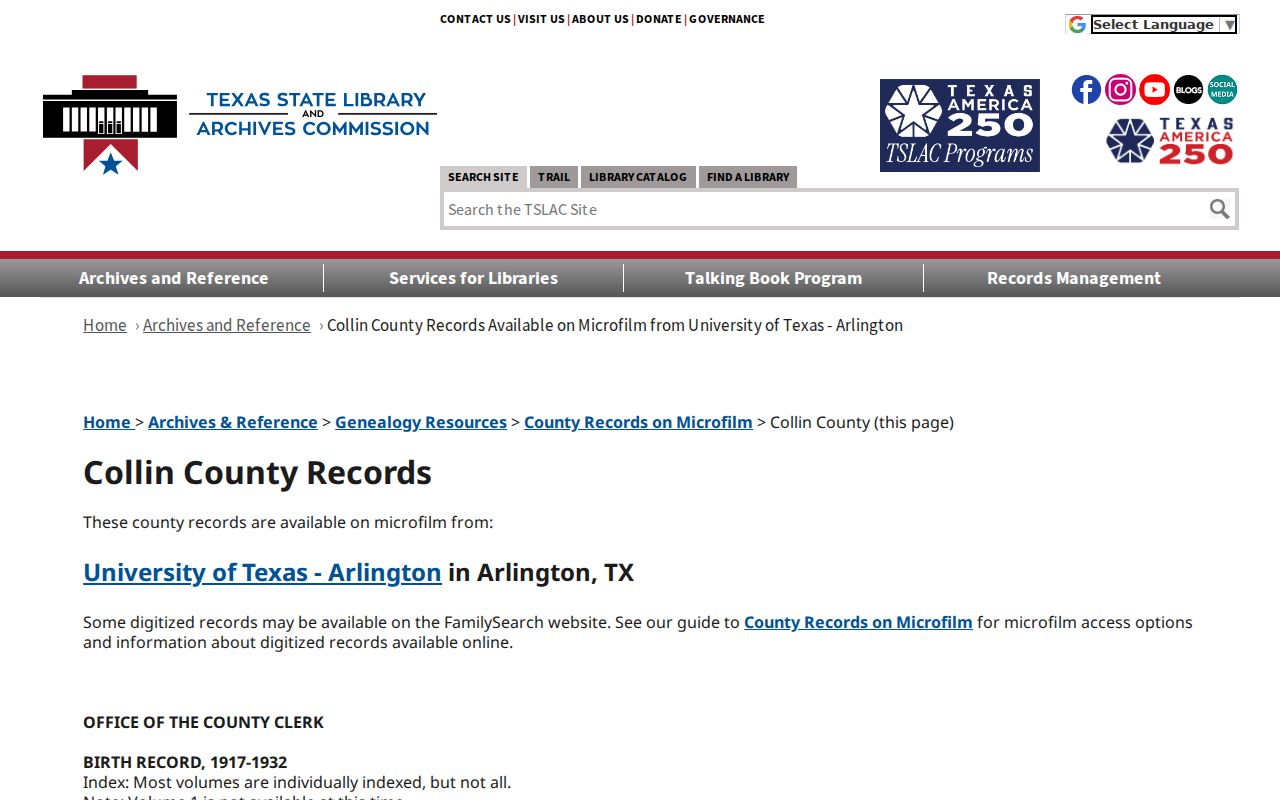
Use the catalogue’s county, place, and reel information to locate a series through a depository or interlibrary-loan route, then confirm the lending rules before assuming an online image exists.
TSLAC lists Deed Record 1846–1921, direct and reverse index runs through 1934, and warnings that volumes A, C, D, or volume 8 may be missing or unfilmed. Retakes can appear at the start of a reel. Probate, civil, birth, and death series have their own gaps. An absent search result can point to a reel or volume limitation rather than prove that an event did not occur.
Collin County Previous Residents in Directories
Reverse or criss-cross directories provide the historical address-to-occupant layer. Start in the street or address section, move to the name section, and check the volume’s abbreviation key. A directory is a dated snapshot. It can provide a surname, initials, spouse or household notation, address, phone, occupation line, or owner and renter notation where a particular volume includes those fields. It should not be treated as a current address claim.
Collin County directory holdings are uneven. McKinney runs include business directories for 1878–79 and 1884–85, the Daily Gazette Directory of 1902, city directories from 1933 and 1938, the Con Survey and business series from 1948 through 1977 in selected years, and city directories for 1982, 1984, and 1985. Plano has 1980 and 1981 directories and telephone books from 1944 and 1947. The digitized 1956 McKinney City Directory is a verified 357-page sample, but each title’s shelf, microfilm, reference-only, or digitized status should be checked.
Local help is distributed rather than concentrated in one house-history service. Plano Public Library’s Research & Learn route, Haggard and CCGS, the Collin County History Museum, and UNT collections each cover part of the trail. The research did not identify one countywide program for researching every house.
Collin County Previous Residents and Census
Pair a directory date with the nearest available census, deed, permit, probate, or obituary rather than asking one record to prove every fact. A deed identifies a legal party. A directory connects a person or household to an address at publication. A census is a household snapshot taken at a census date. A permit can identify a project or applicant. Probate and obituary material can close a family trail after a death or move.
- Copy the exact street spelling, initials, household notation, and directory year from the address section.
- Compare it with the closest public census schedule, preserving the census date and household relationships rather than projecting them forward.
- Test the same name and parcel against a deed, probate index, or permit date to separate owner, occupant, and applicant roles.
- Use an obituary, cemetery survey, family archive, or local newspaper as an endpoint, then corroborate the date with a separate record.
The National Archives 1950 Census resources support the latest public federal census. The 1890 census loss leaves a national gap, and 1960 is not scheduled to open until April 2032. For the directory collections themselves, the Collin County city directory provides the separate collection-focused route.
Collin County Previous Residents Street Names
Historic street names can make a correct address look wrong. Plano’s historic-streets material identifies K Avenue as Main, 15th as Mechanic, and I south of 15th as Mill, Church before 1900, and Interurban. It also identifies 16th west of K as College and G south of 16th and north of 15th as Klepper or Vance. These are search terms, not evidence that a household stayed in place.
When a deed or directory does not match the modern address, test the modern street, an older name, the subdivision, lot and block, parcel ID, and legal description. A plat can translate a subdivision lot or block into the land description used by a deed. Abstract geography can help with an older survey description. Do not treat a failed street-name search as proof that the property or person was absent.
Note: Keep the historic spelling beside the modern form so later directory, map, and deed comparisons remain clear.
Collin County Previous Residents and Sanborns
Sanborn maps date the physical setting, not the household. The Library of Congress holds four sheets for McKinney in 1888 and nine sheets for December 1897. They show building footprints, uses, and street context. A map can set a useful lower bound when a footprint appears before a later permit or remodel record, but it cannot supply a named resident list.
The Library of Congress December 1897 McKinney Sanborn collection is best compared with a same-period deed or directory. The Collin County History Museum research tools also point researchers to Sanborn maps, historical property resources, newspapers, and local archive routes. Pairing the map with a dated directory supplies place and household context without confusing the two kinds of evidence.
Collin County Previous Residents Digitization
Directory access is still expanding. In 2024 and 2025, CCGS reported seeking a UNT mini-grant to digitize surviving Collin County city directories from 1878 through 1999. The project also monitored UNT work on 20 McKinney directories and digitized 1925 and 1926 McKinney Weekly Democrat-Gazette material. This is a practical reason to recheck a missing directory year instead of assuming the local run is complete or permanently unavailable.
The Plano Public Library Research & Learn page is a local starting point for house-history and genealogy help.
A library or historical collection can confirm whether a volume is on a shelf, on microfilm, reference-only, or newly digitized before a historical address conclusion is made.
Collin County Previous Resident Limits
House-history research does not create a current-contact record. Deeds can identify owners, directories can show an address association at a point in time, and probate or obituary material can mark a family endpoint. Each source has a distinct date and role. Never treat a tax owner, a historic directory line, a cemetery mention, or a deed party as proof of a living person’s current location.
Some records have redactions, restricted access, or incomplete survival. The County Clerk’s portal warns that online material may not be complete or unaltered, and court or vital records can have separate confidentiality rules. Ask the responsible custodian for an official copy or a narrowly described existing record when an online result does not answer the question.
Lawful use. Use Collin County previous-resident research for family history, house history, estate and heir questions, or personal curiosity. Repeated unwanted contact, surveillance, threats, or sharing protected information can violate Texas harassment or stalking law.