
Collin County Resident Lookup Records
No single county list settles every question about one person. A parcel record can identify an owner and tax mailing address, while a voter result is a limited registration match. Court indexes put a name in a dated case role. Vital records may confirm a family event, but current certificates have eligibility rules. Begin with the strongest known detail and keep the purpose of each source in view. An owner, party, registrant, licensee, and heir are distinct record roles.
| Record | What It Can Confirm | Where | Access |
|---|---|---|---|
| CCAD parcel | Named owner, mailing or situs address, legal description, and tax context | Collin Central Appraisal District | Public research search; it is not a household roster. |
| Voter form | A registration name and date-of-birth match | Collin Elections | Limited public form; address browsing is not documented. |
| Court case index | Party, court, case type, date, and event trail where shown | Collin Judicial Online Search | Public index subject to sealed and restricted matters. |
| Vital record or index | Birth, death, marriage, or family-event endpoint | County Clerk, DSHS, and historical microfilm | Current certificates have qualified-requester rules. |
| Probate filing | Estate, heir, executor, or administrator clues | County probate search and clerk | Public portions; older records need manual research. |
| License or DBA | Public credential, status, or business filing connection | State boards, SOSDirect, and County Clerk | Use as an affiliation record, not a home-address claim. |
For a current property clue, Collin Central Appraisal District supports owner, street, property-ID, legal-description, subdivision, and neighborhood searches. Its owner and mailing fields are tax-roll evidence. The situs address identifies the parcel, but neither field establishes who physically occupies it.
Start a Collin County Record Search
When a full name and date of birth are known, the Collin Elections form is a useful narrow starting point. The inspected public form shows First Name, Last Name, Date of Birth, and Submit. The live portal returned an unhandled error during inspection, so its current result layout and match message were not established. That is a reason to preserve the exact input details and use an official fallback, not a reason to treat a failed screen as proof that a person is absent.
Collin Elections Voter Registration Search is the official route for the documented name-and-date-of-birth form.
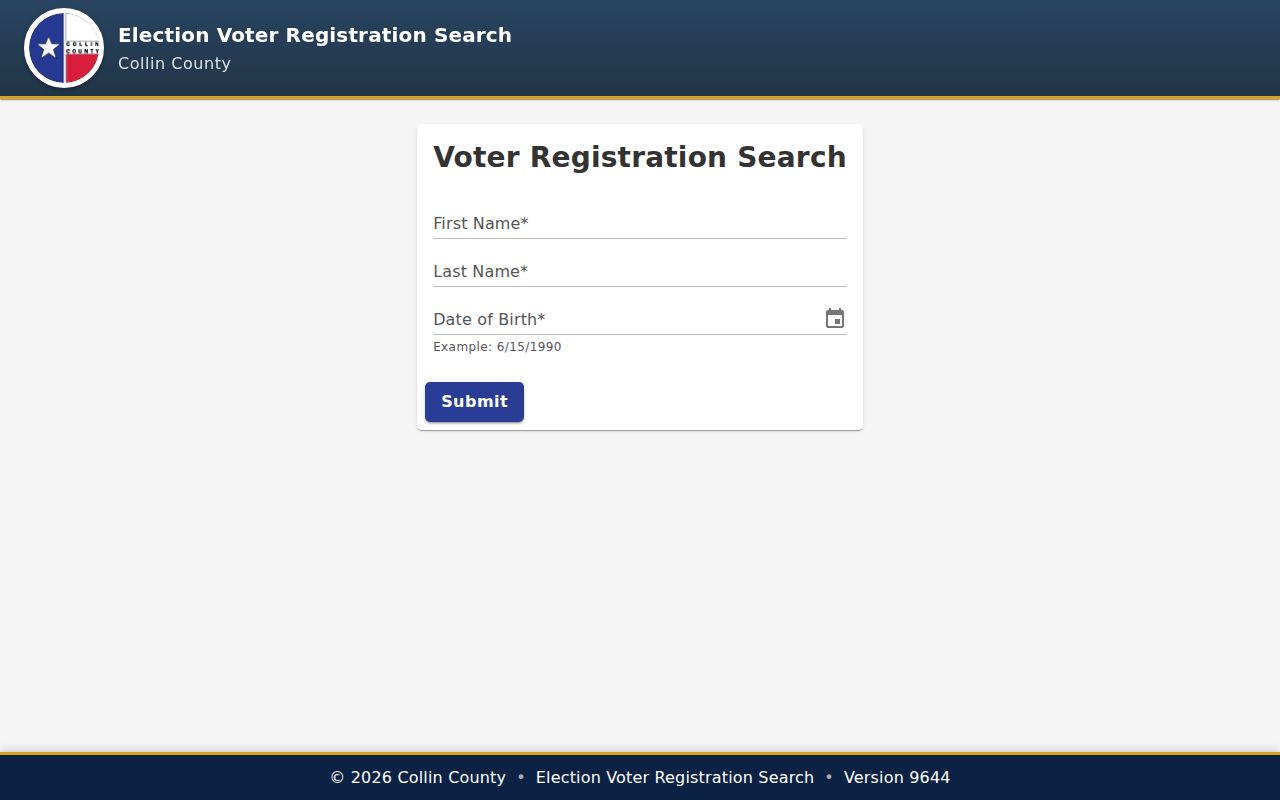
The captured screen shows why the election tool should be approached as a name plus date-of-birth lookup, rather than as a public address or neighborhood browser.
County-only voter files are a separate request route. The Election Store describes public list data such as registration and mailing addresses, districts, registration dates, and voter history, with Active and Suspense choices. Public lookup results remain narrower. A Suspense status can mean an address needs confirmation while a voter remains registered; it is not a cancellation. Election Code Section 18.009 restricts voter-file use, and protected voter information is not a routine county list.
Search Collin County Court Records
Collin County Case Information launches the Judicial Online Search used for District Courts, County Courts at Law and Probate, and Justice Courts. The county's civil guide documents name, case number, citation, and attorney as Search By choices. A name search can be narrowed with last name or company, first name, court group, and case-type selections for criminal, civil, family, or probate cases. The application itself returned an error during inspection, so no stable live result card was treated as guaranteed.
| Field | Documented use | Practical check |
|---|---|---|
| Search By | Name, Case Number, Citation, or Attorney | Choose the identifier already tied to the person. |
| Last Name or Company | Party surname or business/company name | Use a name variation carefully; a shared surname is not enough. |
| First Name | Optional with name search | Add it to reduce same-name results. |
| Court and Case Type | Checkbox groups for court level and case category | Limit the search to the relevant court and record type. |
The Judicial Online Search launch is illustrated by the official service captured below.
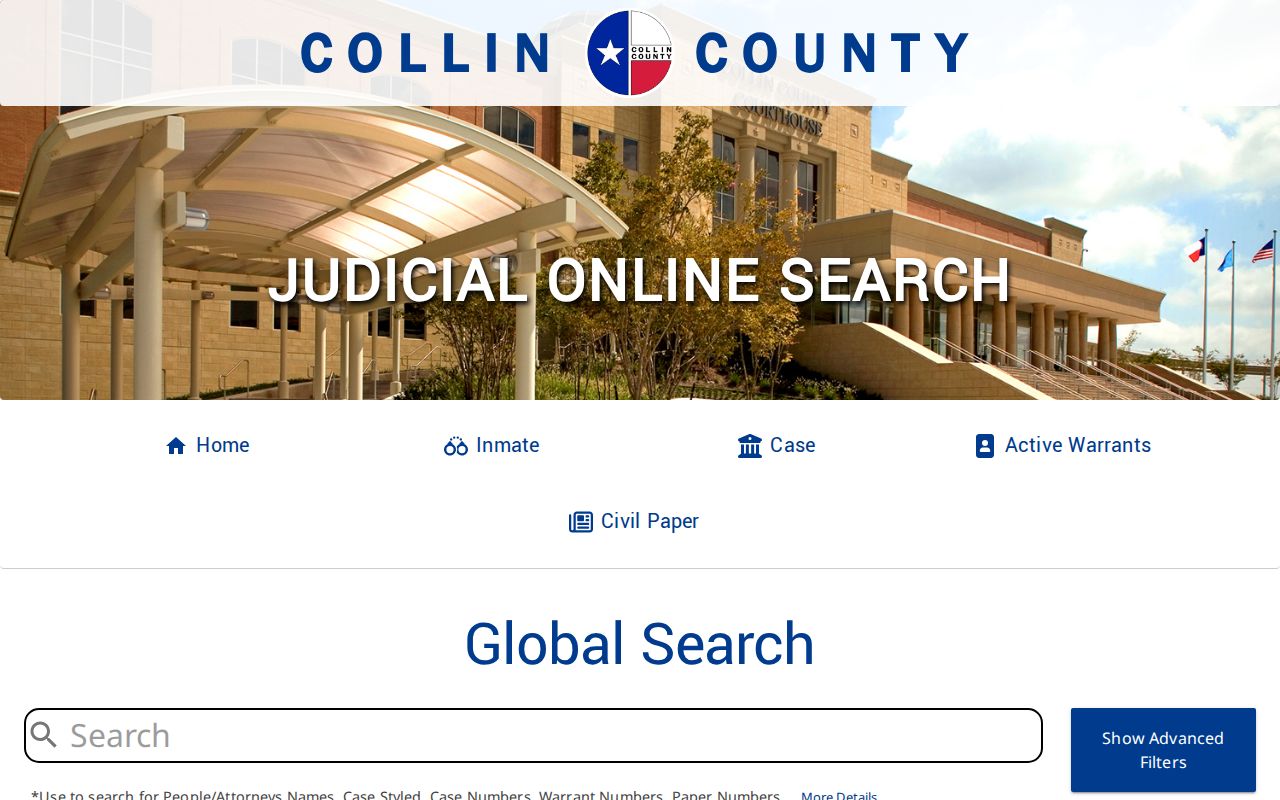
The court-search capture supports a name-based verification step, but a live error means the clerk remains the source for the actual file and any certified copy.
County guidance lists civil District and County Court at Law cases from 1984 forward, District criminal cases from 1988, County Court at Law criminal cases from 2000, and probate and historical JP coverage from 1984. Older ranges need manual clerk research. County Court at Law manual searches cost $5 and require a complete name, date of birth, a self-addressed stamped envelope, and payment. District Clerk requests use a full name and date of birth and may be made in person, by mail, or email with the county record-request form.
Verify a Collin County Resident
Build a dated evidence line before deciding that records identify the same person. Normalize the full legal name, middle initial, suffix, former or maiden surname, and likely spelling variants. Then compare at least two independent attributes. A court party's name plus filing date, a voter name plus date of birth, or a deed party plus legal description can distinguish people better than a shared city name. A current parcel owner, a historical directory entry, and an old deed may all describe different people or different dates.
- Record the complete name and one independent detail, such as date of birth, case number, property ID, or a dated address.
- Check the matching official source. Use the voter form for the documented name-and-date-of-birth route, CCAD for a parcel owner, or the court index for a party name.
- Compare the record role and date with another source. A grantor or defendant is not automatically a current resident.
- For an official document, request the actual record from the maintaining clerk. County guidance says online indexes are not a substitute for clerk-held files.
- Docket
- The court's running case record, often showing case number, parties, dates, events, and a disposition when the public result exposes one.
- Index and image
- An index points to a record through names, numbers, dates, or categories. The image is the document itself, and it may be restricted, redacted, or available only from the custodian.
- Certified copy
- A copy issued or certified by the office that maintains the record. It is the appropriate request when an official document is needed.
Check Collin County Licenses and DBAs
Public business and credential records can verify an affiliation when a person's public work or filing name is already known. The County Clerk's assumed-name search is the local DBA layer, while Texas SOSDirect provides a Find Entity route through a temporary login or account. A DBA and an entity filing can be related, but they are not the same record. Keep the filing date and exact legal name with the result.
TDLR Verify a License searches individuals or businesses by name, license type, city, or county. It can confirm public status, expiration, and county clues for covered license families. The research did not establish a personal address or phone as a dependable result field, so a license entry should never be turned into a private-location claim.
Collin County Vital Record Access
The Collin County Clerk issues Collin birth and death certificates and can issue Texas births through the remote state system. Texas Government Code Section 552.115 opens birth records after the 75th anniversary and death records after the 25th anniversary. Before then, certified copies are limited to the registrant, qualifying close relatives, an informant, or an authorized requester with direct or tangible-interest documentation. An index or a family story does not replace that eligibility.
For current certificates by mail, the county application asks for the event details, applicant relationship, reason for the request, signature, contact information, payment, and, when required, a notarized sworn statement and a government-ID copy. County fees listed in the research are $23 for a birth certificate and $21 for a first death copy, plus $4 for each additional copy of the same death record. DSHS provides statewide certificates and verifications, while marriage and divorce verification is not the same as a locally held marriage license or divorce decree.
Note: Request a vital record only from the lawful custodian and use the statutory access route for the kind of certificate or historical index involved.
Collin County Probate Family Trails
Probate can provide a careful family-history route when a person has died. Start with a probate docket or public filing, then pair it with recorded deeds, an obituary, cemetery material, and the actual estate file from the clerk. The record may identify an heir, executor, administrator, or a date in a family trail. It does not establish a current contact, and sensitive account information or protected details can be redacted. Older probate material, before the stated 1984 online window, calls for manual research.
For a birth parent or biological sibling, use the Texas DFPS Adoption Registry and its statutory process. It is a confidential mutual or eligibility route, not a public address index. Adoption court files are restricted. These official channels let family research respect the privacy rules that apply to living people and adoption records.
Collin County Record Privacy
Texas Address Confidentiality Program participants may use a substitute address and mail-forwarding service when eligible because of family violence, sexual assault, stalking, trafficking, or child abduction. ACP information is confidential and must not be reverse-engineered from a substitute address. Texas Elections also allows protected voters to seek residence-address suppression. An omitted address in a public result does not show that someone moved or that a record is wrong.
Texas law protects some information even when a related record has a public index. Election rules keep Social Security, Texas driver-license, and DPS personal-ID data confidential. Government Code Sections 552.117, 552.130, 552.138, and 552.115 can protect specific personnel, motor-vehicle, crime-victim, birth, or death information. For a correction, contact the true custodian with the document number, parcel ID, case number, or certificate detail and ask for its formal process.
Collin County Resident Lookup Limits
Some official paths stop by design. Juvenile, sealed, expunged, adoption, protected-family, and protected-order matters are not general public search results. A court-index entry does not authorize access to restricted filings. Current voter lookup can fail technically, and protected-voter or ACP information will not appear as an ordinary result. CCAD and deed records can identify an owner or transaction party, but they do not identify every occupant or family member.
When an online result is incomplete, ask the office that created the record for an existing, specifically described record. Give a narrow name, date, address, or case range, and accept lawful redactions. Judicial files follow their clerks and court-access rules rather than ordinary Public Information Act processing. A missing online hit can reflect an older manual range, an access restriction, a name variation, or an out-of-county event.